

AI, smarter bots and why your website probably isn’t hacked.
Over the past year, we’ve been hearing the same question from more and more clients.
“Ever since we changed our website, moved hosting or launched a new version, all we’re getting is overseas spam enquiries. Has something gone wrong?”
It’s an understandable concern. Receiving enquiries written in another language, messages promoting unrelated services or obvious spam through your contact form can be frustrating, especially when it seems to happen overnight.
The good news is that, in most cases, this isn’t caused by your hosting provider, and it doesn’t necessarily mean your website has been hacked.
What has changed is the internet itself.
Artificial intelligence has transformed the way automated bots operate. They’re smarter, faster and significantly better at imitating genuine visitors than they were only a few years ago. At the same time, businesses rely on their websites more than ever before, making contact forms one of the most valuable—and most targeted—parts of a website.
This combination has created a noticeable increase in spam enquiries for businesses of every size, from local trades and professional services to eCommerce stores and national organisations.
The purpose of this guide isn’t to scare you or convince you that your website is vulnerable. It’s simply to explain why spam has become more common, what it actually means for your website and how modern website protection has evolved to deal with today’s internet.
Website Spam Has Changed
Not that long ago, website spam was relatively easy to recognise.
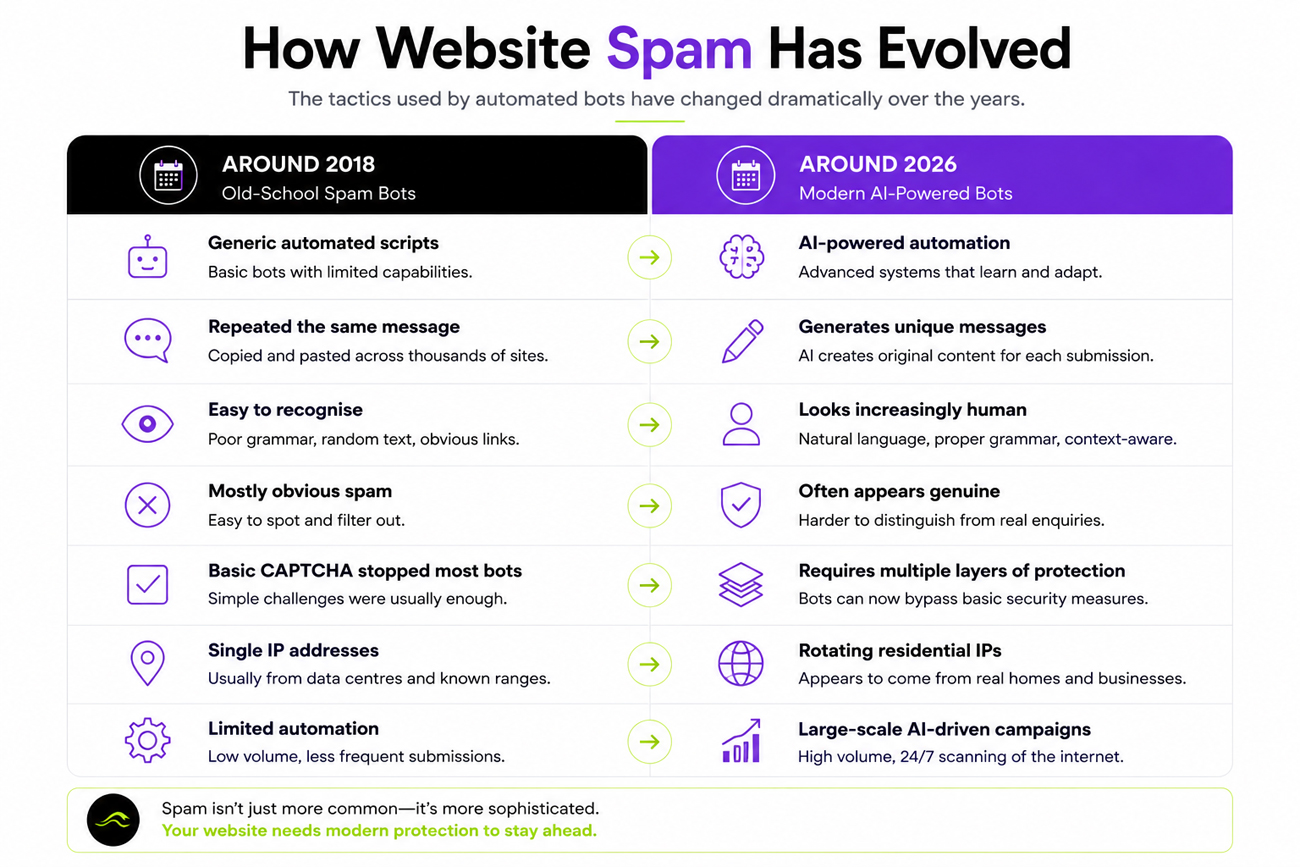
Most messages contained obvious spelling mistakes, random links or generic sales pitches that had clearly been copied and pasted across thousands of websites. Basic CAPTCHA tools were often enough to stop them, and even when the occasional message slipped through, it was usually obvious that it wasn’t a genuine enquiry.
Today’s spam is very different.
Thanks to artificial intelligence and improved automation, modern bots can generate unique messages, write in natural language and even mimic the way real people browse websites. Some pause before submitting forms, vary their wording or rotate between different IP addresses to make themselves appear more like genuine visitors.
Rather than targeting a specific business, these systems continuously scan the internet looking for publicly accessible forms. Your industry, location or company size doesn’t matter. If your website allows customers to get in touch, it’s likely to be discovered eventually.
This doesn’t mean your website is insecure. It simply reflects the way the internet now operates.
Just as AI has helped businesses automate customer service, write marketing content and improve productivity, the same technology has also made automated spam considerably more sophisticated.
Basic protection that worked five or six years ago is no longer enough on its own.
Does Spam Mean My Website Has Been Hacked?
This is probably the biggest concern we hear from clients, and fortunately, the answer is usually reassuring.
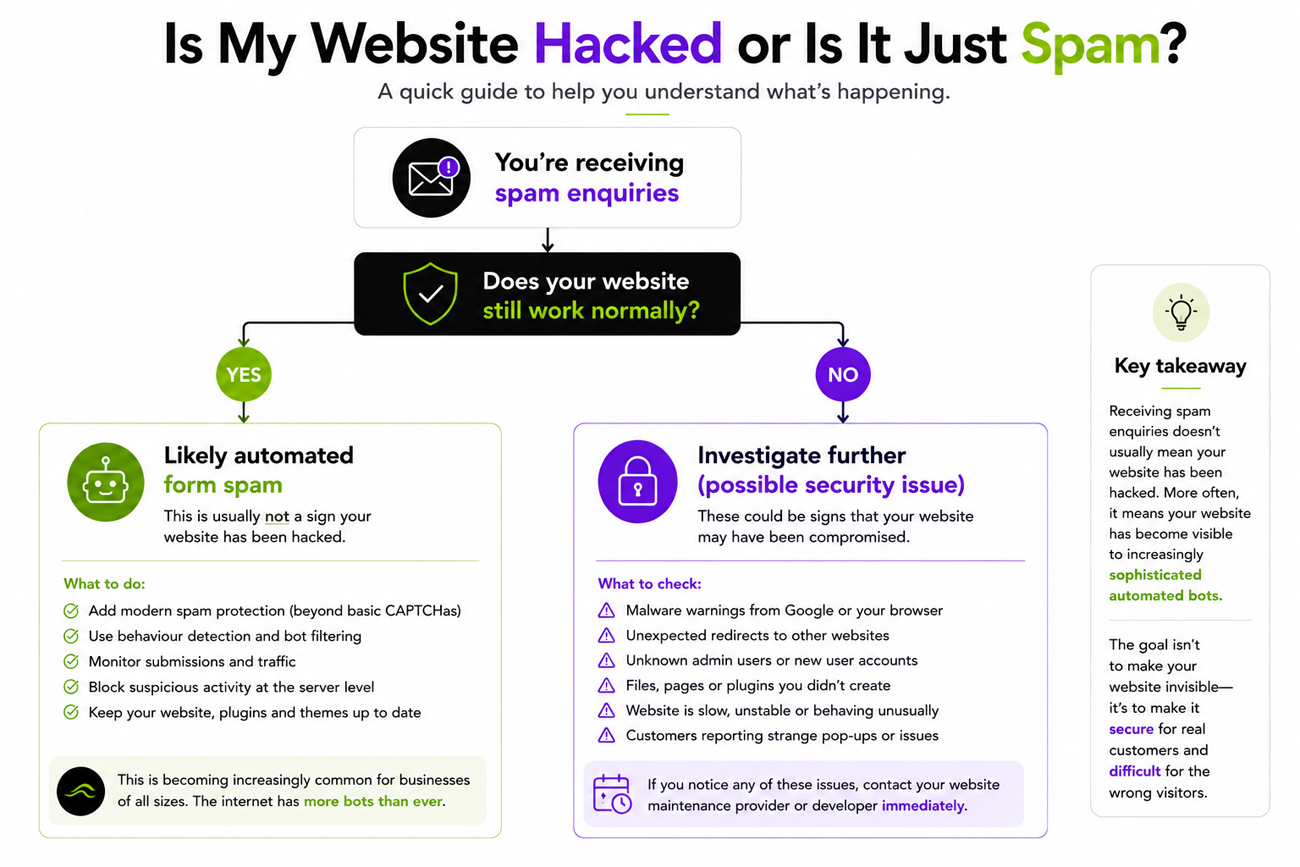
Receiving spam enquiries does not automatically mean your website has been hacked.
Think about your email inbox for a moment.
Most businesses receive spam emails every week. That doesn’t mean someone has compromised your email account—it simply means your email address has become publicly available and automated systems have found it.
Website contact forms work in much the same way.
If your website is publicly accessible, automated bots will eventually discover it. Some will be search engines indexing your content, others will be accessibility tools or SEO crawlers, and a small percentage will be automated systems attempting to submit spam through your contact forms.
Spam alone is rarely evidence of a security breach.
What matters is whether there are other warning signs accompanying it.
If your website continues loading normally, customers can still submit genuine enquiries and the only noticeable change is an increase in spam messages, there’s a good chance your website is simply experiencing the reality of today’s internet.
However, if you notice issues such as unexpected redirects, unknown administrator accounts, malware warnings, missing files or customers reporting unusual behaviour, those are genuine indicators that your website should be investigated further.
The important thing is not to jump to conclusions based on spam alone.
Professional website security is about looking at the complete picture rather than focusing on a single symptom.
When we investigate websites experiencing increased spam, we don’t immediately assume something has been compromised.
Instead, we review the website as a whole.
That includes checking software updates, security settings, firewall protection, contact form configuration and server activity before determining whether the website is genuinely vulnerable or simply receiving more automated traffic than it used to.
More often than not, the website is healthy.
The hosting is working correctly.
The contact form is functioning exactly as expected.
The only thing that’s changed is the volume and sophistication of the automated systems interacting with it.
Why does it feel like every business is receiving more spam than ever before?
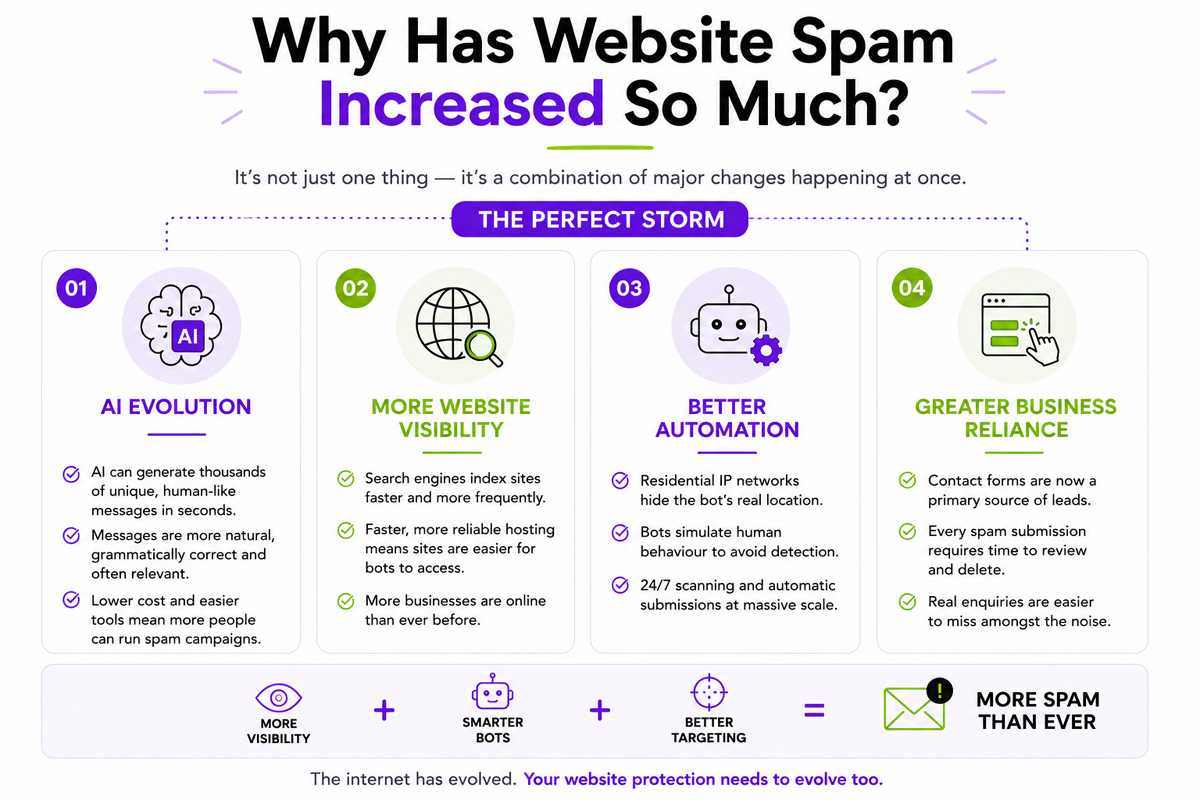
The answer isn’t a single technology or one major event. It’s the result of several changes that have all happened over a relatively short period of time.
Artificial intelligence has made it significantly easier to generate convincing messages at scale. Bots no longer rely on the same repetitive scripts that security systems learned to recognise years ago. Instead, they can create unique content, vary their behaviour and adapt their submissions in ways that make them appear much more like genuine users.
At the same time, websites have become easier to discover. Businesses invest in SEO, Google Ads and faster hosting to improve their online visibility, which is exactly what they should be doing. However, increased visibility doesn’t only attract potential customers. It also means search engines, AI crawlers and automated bots can find your website more quickly.
There’s also been a fundamental shift in how businesses operate online. Twenty years ago, most enquiries happened over the phone or in person. Today, contact forms are often the primary way customers request quotes, book appointments or ask questions. As those forms have become more valuable, they’ve naturally attracted more attention from automated systems.
None of these developments is a problem on its own. Together, however, they’ve created the perfect conditions for website spam to increase across almost every industry.
Modern Website Protection Is Built in Layers
One of the biggest misconceptions about website security is that there’s a single tool capable of solving every problem.
Many business owners assume that installing a CAPTCHA, adding a security plugin or enabling a firewall should eliminate spam entirely. While these tools are all valuable, none of them was ever designed to work in isolation.
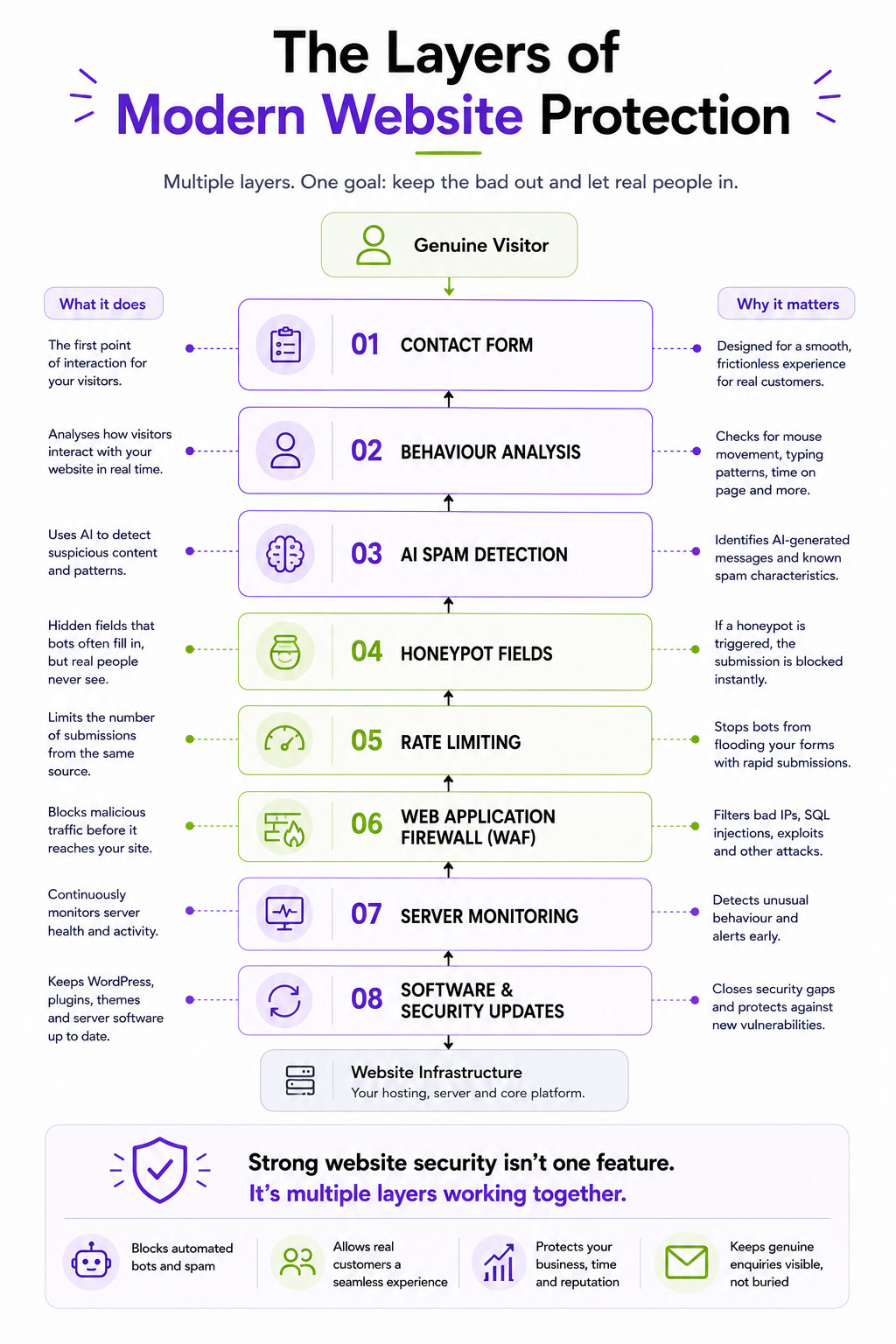
Modern website protection is based on a layered approach.
A good comparison is securing your business premises. You probably don’t rely on a single lock to protect everything inside. You might have quality door locks, an alarm system, security cameras, sensor lighting and insurance. Each layer serves a different purpose, and together they provide far better protection than any one measure could on its own.
Website security works exactly the same way.
Instead of relying on a single feature, modern websites combine several technologies that work together in the background. Some analyse how visitors interact with the website, while others identify suspicious traffic before it reaches your pages. Firewalls filter malicious requests, behavioural analysis helps distinguish genuine users from automated bots, and software updates close newly discovered security vulnerabilities before they can be exploited.
Most of this happens without genuine visitors ever noticing.
In fact, the best website security is often invisible. A customer should be able to complete your contact form quickly and without frustration, while the technology quietly filters suspicious activity behind the scenes.
That balance is becoming increasingly important. Security should protect your website without making it harder for legitimate customers to do business with you.
Keeping Your Website Healthy
The good news is that reducing website spam doesn’t usually require rebuilding your website or changing hosting providers. More often than not, it’s about making sure your website is properly maintained and protected.
That starts with keeping WordPress, plugins and themes up to date, removing software that’s no longer being used and ensuring your contact forms are configured correctly. Regular monitoring, modern spam protection and ongoing security updates all play an important role in reducing unwanted submissions while maintaining a smooth experience for genuine visitors.
Just as importantly, it’s worth reviewing your website periodically rather than waiting until something appears to go wrong. Many security improvements happen quietly in the background, and keeping your website current is often the simplest way to stay ahead of emerging threats.
Website maintenance today is no longer just about fixing broken pages or updating plugins. It’s about ensuring your website continues to perform reliably, remains secure and adapts as the internet evolves.
A Practical Checklist
If you’re wondering where to start, the following checklist provides a solid foundation.
✔ Keep your website, themes and plugins up to date.
✔ Remove plugins and software you no longer use.
✔ Ensure your contact forms are using modern spam protection.
✔ Enable behavioural detection and honeypot fields wherever available.
✔ Review your website’s firewall and hosting security settings.
✔ Monitor unusual traffic and form submission patterns.
✔ Test your contact forms regularly to ensure genuine enquiries are being delivered correctly.
✔ Schedule regular website maintenance rather than waiting for something to go wrong.
None of these steps is particularly difficult on its own.
Together, however, they create a significantly stronger foundation than relying on a single security feature—or assuming your website will continue protecting itself indefinitely.
The Internet Has Changed. Your Website Should Too.
Twenty years ago, a business website was little more than an online brochure. Today, it’s often one of the most valuable assets a business owns. It’s where customers form their first impression, request quotes, book appointments and decide whether they trust your business enough to get in touch.
At the same time, the internet surrounding your website has become far more complex. Search engines, AI systems, accessibility tools, performance monitoring services and countless other automated technologies interact with websites every day. Unfortunately, automated bots are part of that environment too.
Receiving the occasional spam enquiry doesn’t mean your website has failed. More often than not, it simply reflects the reality of operating a public website in today’s digital landscape.
The important question isn’t whether spam exists—it’s whether your website is prepared for the internet as it exists today.
Regular maintenance, modern security practices and ongoing monitoring help ensure your website continues welcoming genuine customers while quietly filtering out the visitors that were never meant to be there in the first place.
If you’ve recently noticed an increase in spam enquiries, a professional website health check can help determine whether you’re simply experiencing the realities of today’s internet or whether there are genuine improvements worth making. In many cases, a few well-planned changes can significantly reduce unwanted submissions while ensuring real customer enquiries continue reaching your inbox.
Ultimately, your website has one purpose: making it as easy as possible for genuine customers to contact your business. Everything else—from security and spam protection to performance and maintenance—exists to support that goal.