ChatGPT Business Hub is here. Will it rival Google Business Profile, and what happens to Google Reviews? Here's what Australian businesses need to know.
OpenAI’s new Business Hub could change how customers discover local businesses. But there’s one part of Google’s ecosystem that might be much harder to replace.
For years, when someone needed a local plumber, electrician, builder or accountant, their first move was pretty simple.
Google it.
They’d search for a service, compare a few businesses, check Google Reviews and hopefully pick up the phone.
But that behaviour is starting to change.
More people are turning to AI tools like ChatGPT to research businesses, compare their options and ask for recommendations without having to scroll through traditional search results.
And this week, OpenAI made an announcement that I think local business owners should pay close attention to.
On 10 November 2026, OpenAI officially launched Businesses in ChatGPT, including a new feature called Business Hub.
Eligible businesses can now claim their presence in ChatGPT, manage their information and access insights into how people are discovering them.
If you’ve ever managed a Google Business Profile, this should sound very familiar.
And I think it’s a pretty big deal.
Think of Business Hub as the beginning of a business management platform built directly into ChatGPT.
Rather than relying entirely on information gathered from websites and other online sources, ChatGPT is now giving eligible businesses a way to verify who they are and provide information directly.
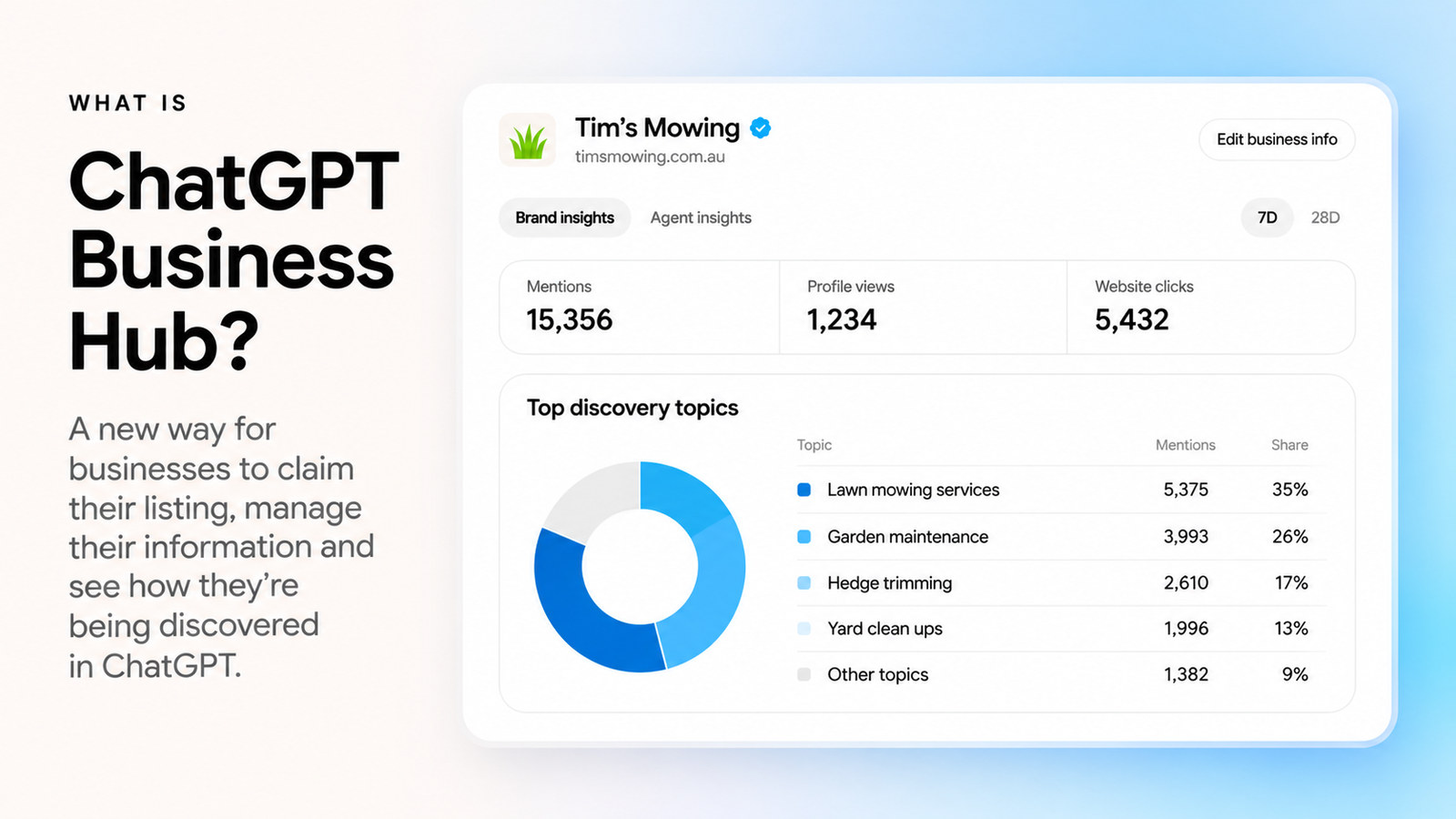
The initial release includes several interesting features:
OpenAI has also introduced Business Agents, allowing eligible businesses to offer a dedicated AI conversation where potential customers can ask questions about their products and services.
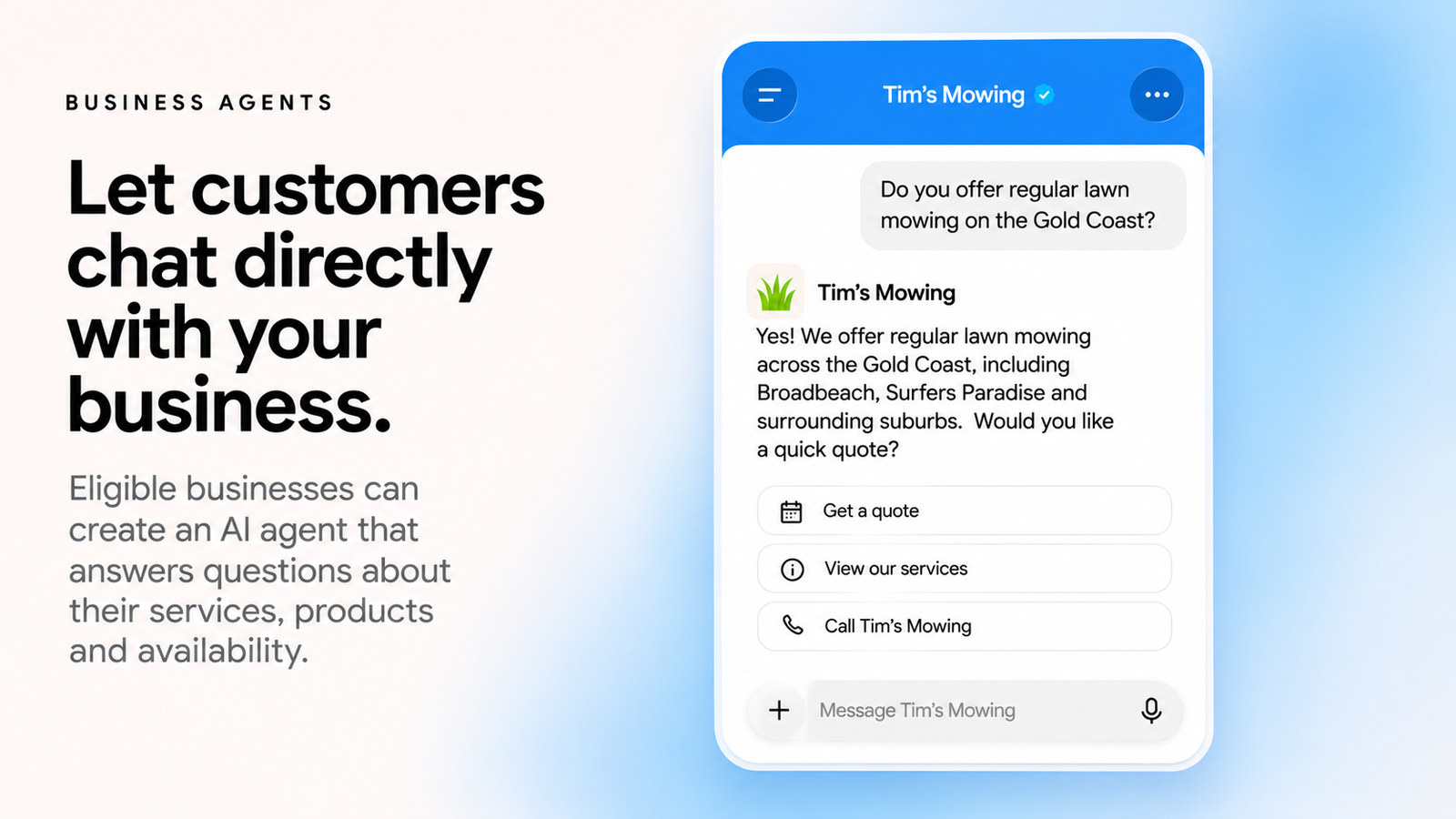
That feature is initially limited to eligible ecommerce and online service businesses in the United States.
But OpenAI has indicated that it plans to expand the platform into additional markets and business categories.
The bigger story isn’t necessarily what Business Hub can do today.
It’s what this signals about the future of business discovery.
Not exactly. At least not yet.
Google Business Profile has become one of the most valuable marketing assets for local businesses.
It helps customers discover businesses through Google Search and Maps, read customer reviews, check opening hours, get directions and make contact.
For many local service businesses, it’s a major source of enquiries.
ChatGPT Business Hub is different, but I can see some obvious similarities.
Both platforms give businesses a way to influence how they’re represented when potential customers are looking for information.
The difference is how people search.
On Google, someone might type:
“Best electrician Gold Coast”
In ChatGPT, they might ask:
“I’m renovating a house in Broadbeach and need a reliable electrician who specialises in high-end residential work. Who should I consider?”
That’s a much more detailed question.
The customer isn’t necessarily looking for a list of websites. They’re asking for help making a decision.
And that changes the opportunity for businesses.
Instead of competing solely for a position in traditional search results, businesses increasingly need to consider whether AI platforms understand what they do, where they operate and why someone should choose them.
But there’s one very important part of Google’s ecosystem that I think people might be underestimating.
Google has spent years building something that would be incredibly difficult for a new competitor to recreate overnight.
Google Reviews.
Think about how much customer feedback is already sitting inside Google’s ecosystem.
Years of reviews, ratings, customer photos, detailed experiences and business responses.
For local businesses, that represents an enormous amount of social proof.
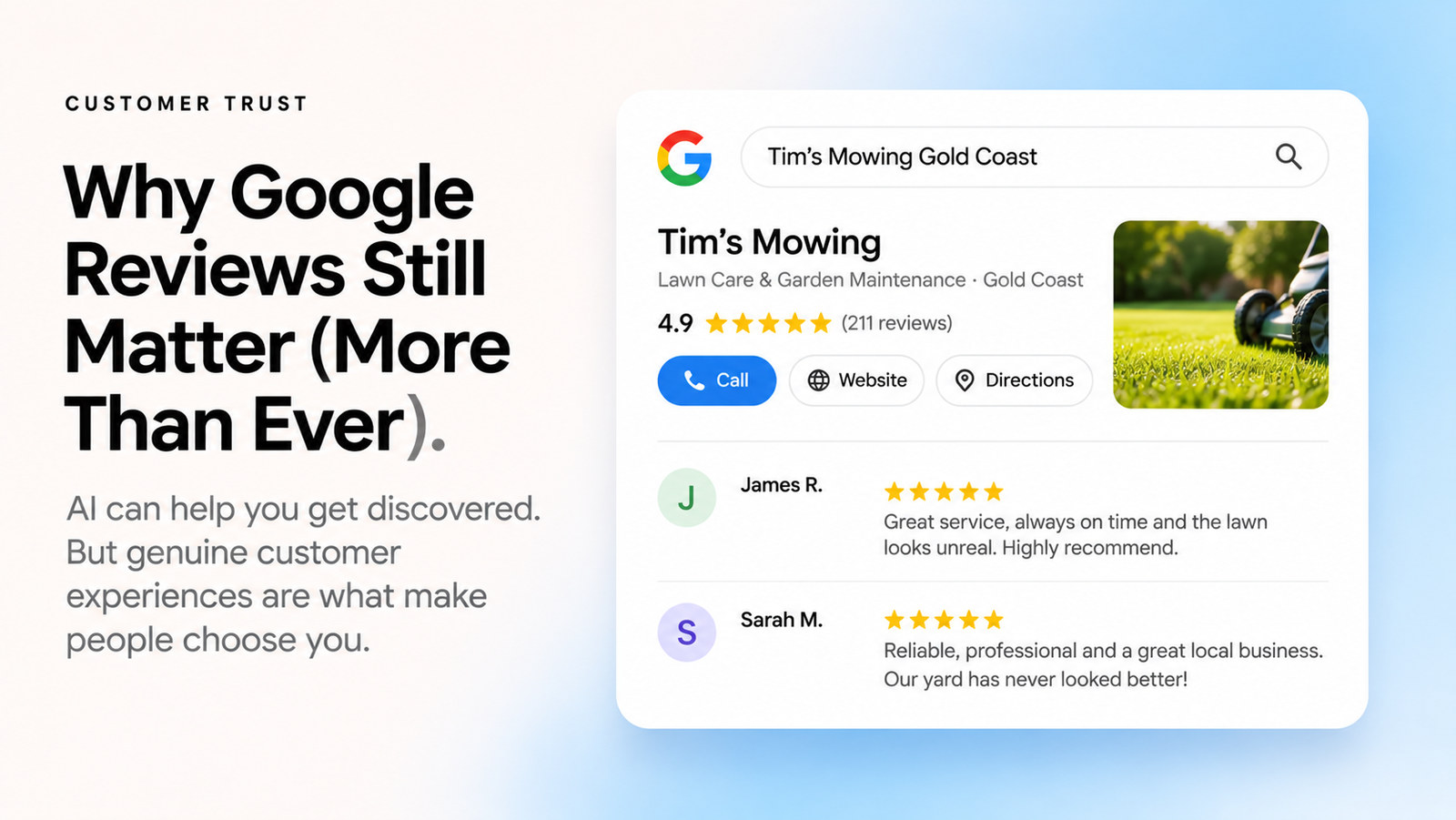
And while ChatGPT might eventually become a better way to discover and compare businesses, I think there’s a genuine question about whether it could ever replace that level of customer feedback.
In fact, I’d argue that genuine human testimonials could become even more valuable as AI becomes more widespread.
Think about it.
We’re entering a world where AI can generate an impressive website, write convincing marketing copy, create professional-looking images and make almost any business sound like the best in its industry.
The barrier to looking professional online is getting lower every day.
But looking like a great business and actually being a great business are two very different things.
That’s where genuine customer experiences become incredibly important.
When I’m choosing a builder, mechanic or local tradesperson, I don’t just want to know what the business says about itself.
I want to know what actual customers have experienced.
Did they turn up on time? Was the work good? Did they communicate properly? Would that customer recommend them?
Those are things that polished marketing copy, whether written by a human or AI, can’t independently verify.
Reviews aren’t perfect. They can be manipulated, and even genuine feedback doesn’t tell the whole story.
But a strong history of detailed, authentic customer experiences is still incredibly valuable.
It’s certainly an interesting possibility.
OpenAI hasn’t announced a customer review platform comparable to Google Reviews as part of this Business Hub release.
But if ChatGPT becomes a major way people discover local businesses, it raises an obvious question.
Will ChatGPT eventually develop its own review ecosystem, or will it continue relying on information from existing platforms?
I don’t know the answer.
But I wouldn’t underestimate Google’s position here.
Google already has an enormous head start, particularly when it comes to local businesses and customer reviews.
And even if ChatGPT becomes the place where someone asks for a recommendation, Google Reviews could remain one of the places they go to validate that recommendation.
That doesn’t mean ChatGPT will necessarily rely on Google Reviews when generating its answers. How individual review sources influence AI recommendations remains uncertain.
But from a customer’s perspective, the need for independent evidence of a business’s reputation isn’t going away.
As AI-generated content becomes increasingly common, I think the businesses that can demonstrate genuine customer satisfaction will have a major advantage.
That means authentic Google Reviews, detailed testimonials, real project photos, customer videos and genuine case studies.
Not manufactured five-star ratings.
Not generic AI-written testimonials.
Actual evidence from actual customers.
For local business owners, my advice is simple.
Don’t stop investing in your Google Reviews just because AI search is taking off.
If anything, I’d be doubling down on collecting genuine customer feedback.
Because while the technology customers use to find your business might change, the fundamental reason they choose you probably won’t.
Trust.
And I think that’s going to become one of the most valuable assets a local business can build.
At New Wave Digital Marketing, we work with service businesses that depend on generating quality local enquiries.
That might be a builder wanting more renovation projects, an electrician targeting a particular type of installation or a professional services business trying to attract the right clients.
Traditionally, our local SEO strategies have focused on building strong websites, targeting relevant search terms, optimising Google Business Profiles and improving a business’s local reputation.
Those fundamentals are still important.
But now there’s another question we need to ask.
When someone asks ChatGPT to recommend a business like yours, does it know enough about your business to recommend you?
I think this is where local SEO is heading.
It’s no longer just about rankings. It’s also about ensuring your business is clearly understood by the platforms people use to discover services.
That means having accurate business information across the internet, creating useful service-specific content, demonstrating genuine experience and maintaining a credible online reputation.
Consider two local building companies.
One has a basic website that says:
“We provide high-quality building services across the Gold Coast.”
The other has detailed pages explaining its renovation services, the suburbs it works in, examples of completed projects, customer testimonials and the types of projects it specialises in.
Which business is easier for a customer to evaluate?
And which business provides more useful information for an AI system trying to understand the services it offers?
The second business clearly provides more context.
That doesn’t guarantee ChatGPT will recommend it, but it illustrates why detailed, accurate and genuinely helpful website content matters.
These have always been good SEO principles.
AI discovery makes them even more relevant.
One part of this announcement particularly caught my attention.
OpenAI says businesses will be able to access insights into how they’re being discovered in ChatGPT.
That includes business mentions, website clicks and common discovery topics.
For marketers, that’s fascinating.
One of the challenges with AI-driven discovery has been understanding how often a business is being discussed or recommended when there isn’t necessarily a traditional website visit.
Imagine being able to see that people are discovering your building company while researching home renovations, or that your accounting practice is appearing in conversations about business tax advice.
That’s the sort of information that could eventually help businesses understand customer demand and improve their content strategies.
There are limitations.
These are aggregated insights, not access to individual customer conversations. Reporting is also subject to privacy thresholds, and it doesn’t necessarily tell you whether a mention resulted in a paying customer.
Still, it’s an important first step towards making AI discovery more measurable.
And for businesses investing in local SEO, that’s something worth watching.
There is an important catch.
Business Hub has launched in beta, and eligibility depends on the business and available verification methods.
OpenAI says eligible businesses in countries where ChatGPT is available can apply to claim their listings.
That potentially includes Australian businesses, but it doesn’t mean every local business will be able to claim and manage its profile immediately.
When we tried to claim New Wave’s listing in ChatGPT Business Hub from Australia on 12 November 2026, we were put on a waitlist. We’ve already joined it.
Business Agents are currently restricted to eligible ecommerce and online service businesses in the United States.
For Australian trades and local service businesses, certain features may take longer to become available.
My advice would be to check whether your business is eligible, but not to assume every feature is available yet.
And definitely don’t neglect your existing Google Business Profile while waiting.
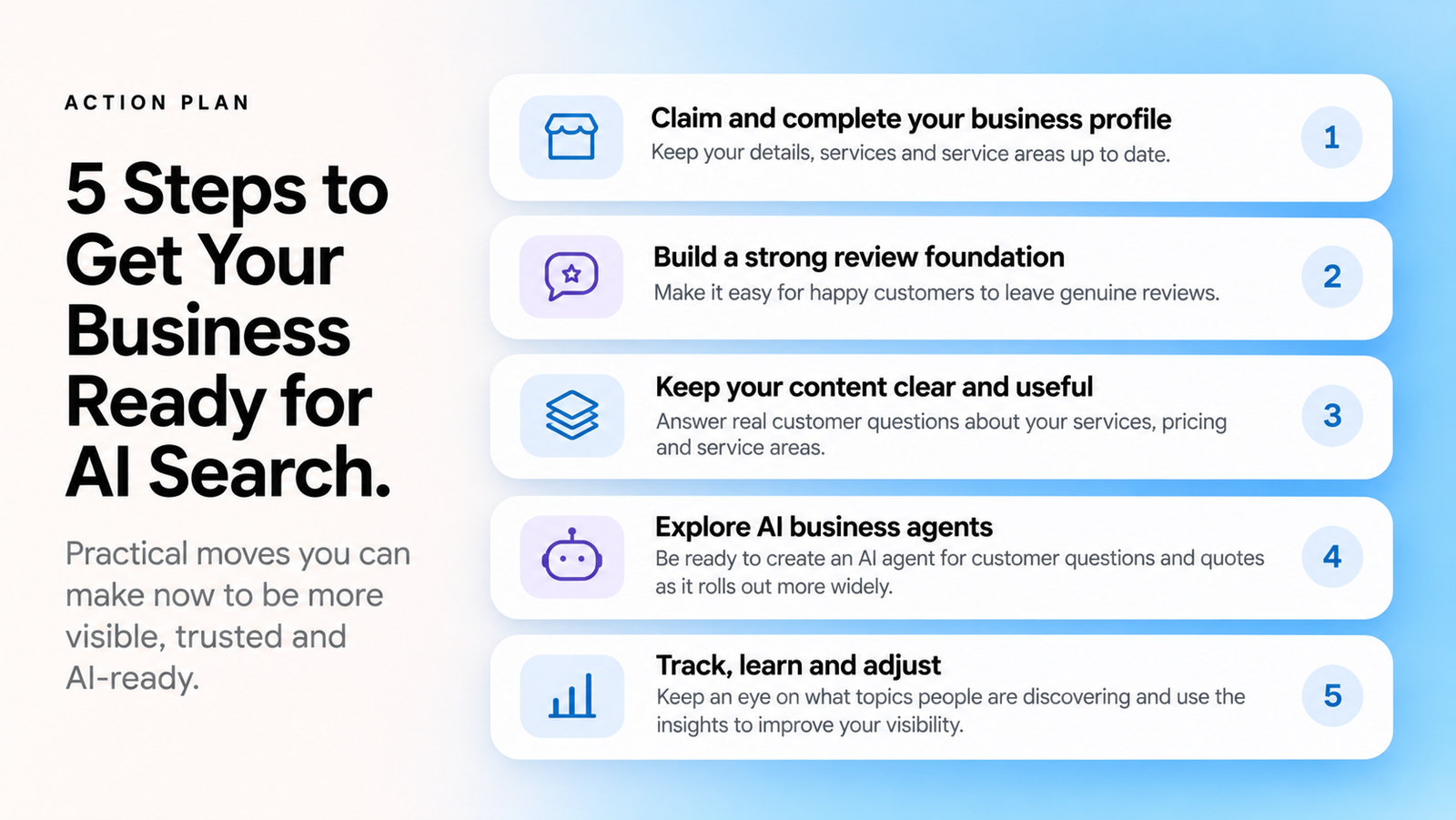
Even if you can’t claim your business in ChatGPT today, there are some practical steps worth taking.
Ask ChatGPT what it knows about your business, your services and your location.
Try realistic questions that potential customers might ask.
For example:
“Can you recommend a residential builder specialising in renovations on the Gold Coast?”
See which businesses appear and what information ChatGPT uses to describe them.
Just remember that AI responses aren’t definitive rankings. Results can vary depending on the question, location and conversation context.
Your website should communicate your core services, specialisations, service areas and the types of customers you help.
Avoid vague descriptions that could apply to any business in your industry.
Detailed service pages, project examples and genuinely helpful information give both people and search systems more useful context.
Make sure your Google Business Profile, website, business directories and other important online listings contain accurate information.
That includes your business name, contact information, services, service areas and operating hours.
This is already good local SEO practice.
This is the one I’d be particularly focused on.
Build a consistent process for asking satisfied customers to leave honest reviews.
Encourage genuine feedback, document completed projects and collect customer testimonials where appropriate.
Video testimonials and real project examples can be particularly useful because they help potential customers see the people and work behind the business.
We don’t yet know exactly how different review platforms will influence ChatGPT’s business recommendations.
But we do know that reputation matters when real people make purchasing decisions.
Visit OpenAI’s Businesses in ChatGPT page (https://openai.com/business/businesses-in-chatgpt/) to check whether you can claim your business.
If you’re eligible, complete the verification process and make sure the information you provide is accurate and current.
As the platform develops, keep an eye on what new features become available to Australian businesses.
I don’t believe Google is disappearing anytime soon.
Google Search, Google Maps and Google Business Profiles remain incredibly important for local businesses.
And I think Google’s enormous ecosystem of genuine customer reviews gives it an advantage that will be difficult for competitors to replicate.
But I also think we’re moving towards a world where customers discover businesses across multiple platforms, including AI assistants.
That means businesses will need to think differently about their online presence.
We’re already seeing search evolve from simple keywords towards more conversational questions and personalised recommendations.
Now OpenAI is introducing the infrastructure for businesses to participate more directly in that experience.
Business Hub is still early, and there are plenty of unanswered questions around eligibility, visibility, customer reviews and how much influence businesses will actually have over their presence.
But I wouldn’t ignore it.
My prediction is that managing how your business appears in AI recommendations will eventually become a normal part of local SEO, much like managing your Google Business Profile is today.
And I believe there’s an equally important shift happening alongside it.
As AI makes it easier for every business to produce polished marketing content, genuine customer experiences could become one of the most important ways to stand out.
AI might become the new way customers discover businesses. But genuine human experiences might become the most important reason they choose one.
At New Wave Digital Marketing, we’ll be watching this rollout closely and exploring how AI discovery fits into our existing local SEO, reputation management and lead generation strategies.
Because ultimately, the objective hasn’t changed.
It’s about making sure the right customers can find your business, understand what makes you different and have enough confidence to get in touch.
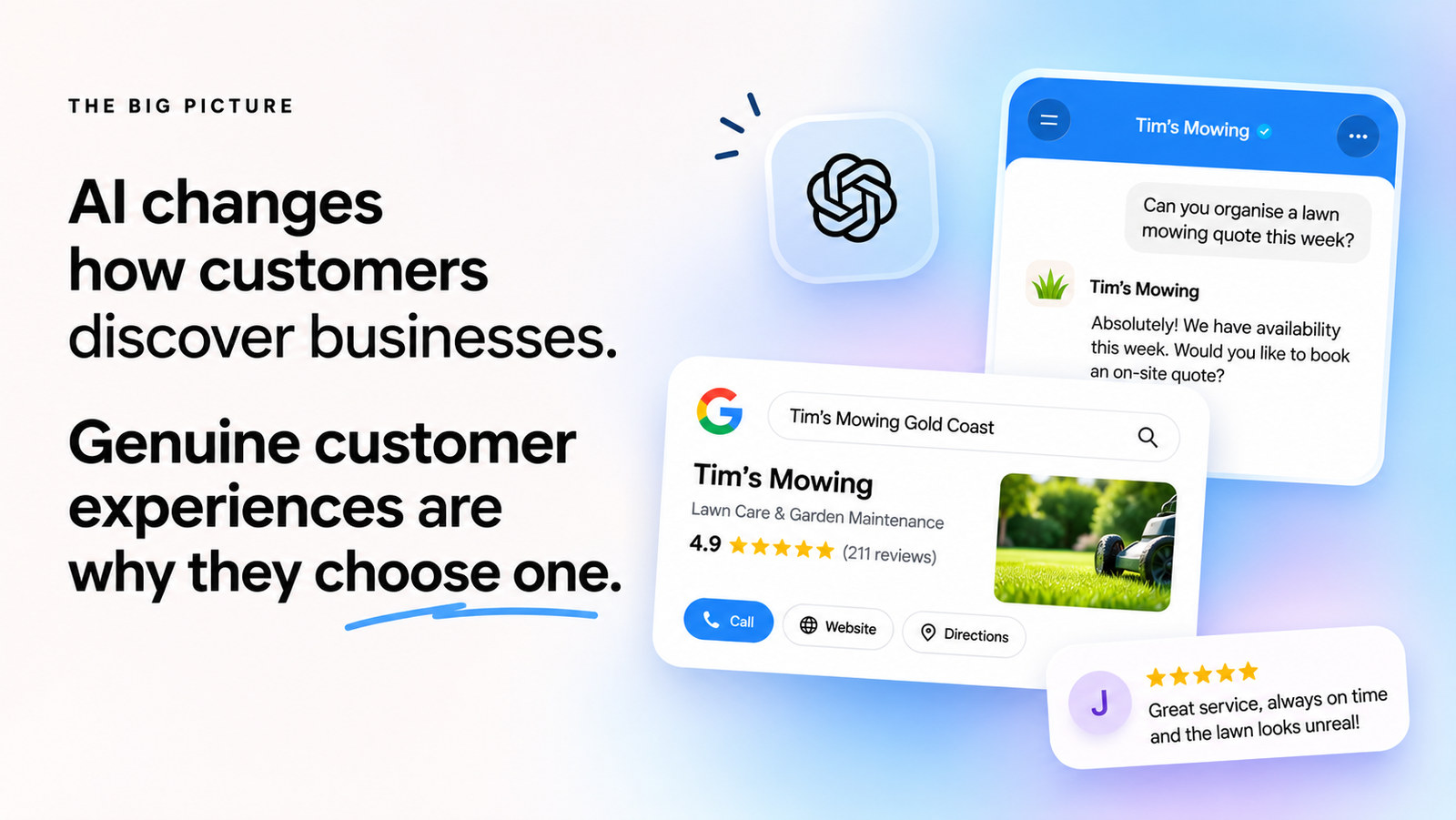
The way customers find you is evolving. The importance of earning their trust isn’t.
At New Wave Digital Marketing, we help Australian service businesses attract more qualified enquiries through local SEO, website optimisation, Google Business Profile management and digital lead generation.
As AI changes how customers search for businesses, we’re continuing to explore how these emerging platforms fit into a modern local lead generation strategy.
Learn more about New Wave Digital Marketing (https://newwavedigitalmarketing.com.au/)
Source: OpenAI, Introducing Businesses in ChatGPT, 10 November 2026 (https://openai.com/index/introducing-businesses-chatgpt/).
Free calculator
Most business owners have no idea how much revenue their Google ranking is leaving on the table. Find out yours in 2 minutes.
Calculate What #1 Is Worth →Free · No sales call